Tuesday, October 29, 2013

swirl: Learning Statistics & R

Most of us would acknowledge that getting up to speed with R involves a pretty steep learning curve - but it's worth every drop of sweat we shed in the process!

If you're learning basic statistics/econometrics, and learning R at the same time, then the challenge is two-fold. So, anything that will make this feasible (easy?) for students and instructors alike deserves to be taken very seriously.

Enter swirl - "statistics with interactive R learning" - developed at the Department of Biostatistics, Johns Hopkins University.  It's dead easy to download and install swirl - it just takes a few moments, and you're underway.

There are simple, interactive, lessons that introduce you to the essential concepts, and you have the option to watch related videos. If you need to take a break part way through a lesson then you can save what you've completed, and pick up from that point at a later time.

My guess is that students will find swirl appealing and very helpful.


© 2013, David E. Giles

Sunday, October 27, 2013

The Joys of Publishing!

I owe a VERY BIG hat-tip to Arthur Charpentier (he of the Freakonometrics blog) for alerting me to this one!

Getting your work published can pose interesting challenges at the best of times. But what about at the worst of times? 

Rick Trebino, of the School of Physics at Georgia Tech., tells us "How to Publish a Scientific Comment in 1 2 3 Easy Steps". I just love it!

Here's how Rick's story begins:

The Future of Statistical Sciences Workshop

No doubt you know, already, that 2013 has been the International Year of Statistics. To that end, there's been a veritable smorgasbord of activities and events promoting the discipline, and the contributions of statisticians far and wide.

The capstone event for Statistics2013 is "The Future of Statistical Sciences Workshop", to be held in London (England) on 11 and 12 November.

This workshop
"...will showcase the breadth and importance of statistics and highlight the extraordinary opportunities for statistical research in the coming decade.
This invitation-only workshop will be an opportunity for presenters, all statisticians and organizers to think about where statistics should go as a discipline and the lessons learned in the past that will guide us into the future. During this unique event, statistical scientists and scientists from other disciplines will interact and chart a shared vision for the future."
There are some great speakers lined up for this two-day event, and although the workshop is invitation-only, you can register now for the associated webinar.

And don't forget The Unconference on the Future of Statistics!
© 2013, David E. Giles

Saturday, October 26, 2013

Segmented Regression - Some (Relatively) Early References

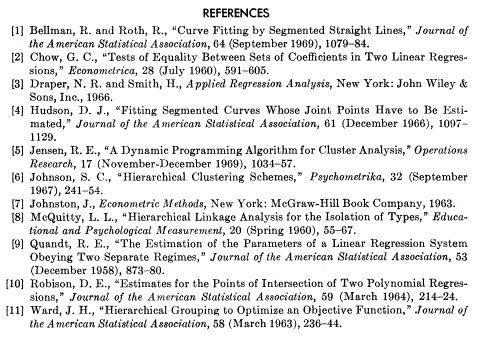
In response to a recent post of mine on "segmented regression", an anonymous reader asked if I knew when such regressions first appeared in the literature. I'm not sure of the very first reference, but there was certainly an active literature on this by the mid 1960's.

One good reference is V. E. McGee and W. T. Carleton (1970), "Piecewise Regression", Journal of the American Statistical Association, 65, 1109-1124. Those authors cite the following other material, which includes several earlier papers on this topic:

Hopefully, this is helpful.


© 2013, David E. Giles

Friday, October 25, 2013

Chris Sims on Bayesianism

I just love this piece by Chris Sims: "Bayesian Methods in Applied Econometrics, or, Why Econometrics Should Always and Everywhere Be Bayesian", from 2007.

In addition to the solid content, there are some great take-away snippets, such as:

  • "Bayesian inference is hard in the sense that thinking is hard."
  • "(People) want to characterize uncertainty about parameter values, given the sample that has actually been observed."
  • "Good frequentist practice has a Bayesian interpretation."

  • And Sims' conclusion: "Lose your inhibitions: Put probabilities on parameters without embarrassment."

    I can live with that!

    © 2013, David E. Giles

    Tuesday, October 22, 2013

    Solution to the Segmented Regression Problem

    Here's my solution to the "segmented regression" problem that I posed yesterday. Thanks for the comments and suggestions!

    You'll recall that what we wanted to do was to end up with a fitted least squares "line" looking like this:

    In particular, the "kink" in the line is at a pre-determined point - in this example when x = 30.

    Here's how we can achieve this:

    Money 101: Top Resources for Finance Majors


    Abigail Moore, the Content Creator at OnlineFinanceDegree.org, emailed me today:

    "I'm writing with the exciting news that our latest article, "Money 101: Top Resources for Finance Majors," has been published, and Econometrics Beat: Dave Giles' Blog is cited on it.
    Finance is an engaging and highly competitive professional field to get into. For those studying finance, the internet can offer a wealth of resources. That said, it can be hard to sift through and find the best. We hope this feature will help finance students find information about financial organizations, current economic news, financial modeling software and techniques, and the finance industry as a whole. Your site is a valuable addition to this resource.
    We're hoping to share this article with as many finance students and professionals as possible and will be contacting our readers and followers. If you're able to post this on your website or share the article anywhere else you can think of too, I'd really appreciate it." 
    No problem, Abigail - happy to oblige. You'll find this blog listed as site #8.


    © 2013, David E. Giles

    Monday, October 21, 2013

    Lawrence R. Klein, 1920-2013

    One of the great figures of econometrics passed away yesterday. Lawrence Klein was the father of whole-economy macroeconometric modelling, and his massive contributions to this field earned him the Nobel Prize in 1980.

    Klein created some of the earliest simultaneous equations models of the U.S. economy (e.g., see here), and he was the driving force behind countless such models for other economies around the world. Among other things, Klein was responsible for the foundation of Project LINKin 1968. This ambitious endeavour now brings together econometric models for 78 countries to provide a "world econometric model".

    Lawrence Klein shaped econometric modelling, and his passing marks the end of an amazing era.

    Businessweek's obituary for Lawrence Klein can be found here.


    © 2013, David E. Giles

    A "Segmented" Regression Problem

    Here's a little exercise for the students among you.

    Suppose that we want to fit a least squares regression model that allows for a "break" in the underlying relationship at a particular sample value for the regressor(s). In addition, we want to make sure that the fitted model passes through that sample value.

    In other words, we want to end up with a fitted model that gives a result such as this:

    Here, the two segments of the regression line "join" when X=30. What's a simple way to achieve this?


    © 2013, David E. Giles

    Monday, October 14, 2013

    Economics Nobel Prize, 2013

    The waiting is over - the 2013 Nobel in Economics was announced this morning! Most deservedly, it has been awarded to Eugene F. Fama (U. Chicago), Lars Peter Hansen (U. Chicago), and Robert J. Shiller (Yale U.). The citation says: "For their empirical analysis of asset prices". 

    For more details, see here.

    It's really  nice to see the recognition of empirical research.

    And let's not forget that Hansen gave us GMM estimation; and do you recall Shiller distributed lag models?


    © 2013, David E. Giles