Friday, December 6, 2013

The Washing Machine Repairman

Here's a fun quote.
"As I remember, Bill X fixed my washing machine. My husband, Harry X, brought him home to talk economics after a Cambridge dinner in hall and they walked in on my frustration with the washer. I met a slight-statured, quiet man who modestly asked if he could help. He tried something with a screw-driver which may have worked - or perhaps it didn't work - and went back to talking economics'"

Who were  "Harry" and Bill?


© 2013, David E. Giles

Thursday, December 5, 2013

Econometrics and "Big Data"

In this age of "big data" there's a whole new language that econometricians need to learn. Its origins are somewhat diverse - the fields of statistics, data-mining, machine learning, and that nebulous area called "data science".

What do you know about such things as:
  • Decision trees 
  • Support vector machines
  • Neural nets 
  • Deep learning
  • Classification and regression trees
  • Random forests
  • Penalized regression (e.g., the lasso, lars, and elastic nets)
  • Boosting
  • Bagging
  • Spike and slab regression?

Probably not enough!

If you want some motivation to rectify things, a recent paper by Hal Varian will do the trick. It's titled, "Big Data: New Tricks for Econometrics", and you can download it from here. Hal provides an extremely readable introduction to several of these topics.

He also offers a valuable piece of advice:
"I believe that these methods have a lot to offer and should be more widely known and used by economists. In fact, my standard advice to graduate students these days is 'go to the computer science department and take a class in machine learning'."
Interestingly, my son (a computer science grad.) "audited" my classes on Bayesian econometrics when he was taking machine learning courses. He assured me that this was worthwhile - and I think he meant it! Apparently there's the potential for synergies in both directions.


© 2013, David E. Giles

Wednesday, December 4, 2013

The International Association for Applied Econometrics

Here's an organisation that deserves promoting - The International Association for Applied Econometrics. What more can I say?

Well, I had better add something!

First:
"The aim of the Association is to advance the education of the public in the subject of econometrics and its applications to a variety of fields in economics, in particular, but not exclusively, by advancing and supporting research in that field, and disseminating the results of such useful research to the public."
Second:

There next Annual Conference will be held in London, U.K., in June 2014, and the line-up of keynote speakers is impressive. Submissions of papers are due by 1 February 2014, and there is a nice prize for the best paper presented by a graduate student.


© 2013, David E. Giles

Friday, November 29, 2013

Do You Have a Tattoo?

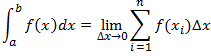
Significance Magazine  is a joint publication of the Royal Statistical Society and the American Statistical Association. The "News" section of the latest issue (which can be read by subscribers) contains an item titled, "More Than Skin Deep". It's about a mathematics teacher who has an interesting tattoo:


In case you need an interpretation, it reads:  
                                                          
The item concludes:
"It attracts attention. Often on a beach someone will say something like 'You're either a math teacher or in a really, really odd motorcycle gang.'
Why should statisticians lag behind? A bottle of champagne to the first reader who can show a permanent tattoo of Bayes' theorem - preferably on a part of the anatomy that we can decently reproduce."
Needless to say, this got me thinking! Are there any Econometrics tattoos out there that I should be aware of?


© 2013, David E. Giles

Lawrence R. Klein Memorial Prize

Nobel Laureate Lawrence R. Klein passed away in October of this year in Philadelphia. (See here.) 

Empirical Economics has established a prize in his honour given for the best empirical paper published in the last two years in the journal. An upcoming issue of Empirical Economics will include an obituary written by Badi Baltagi.


© 2013, David E. Giles

Monday, November 25, 2013

A Bayesian View of P-Values

"I have always considered the arguments for the use of P (p-value) absurd. They amount to saying that a hypothesis that may or may not be true is rejected because a greater departure from the trial was improbable: that is, that it has not rejected something that has not happened'"
H. Jeffreys, 1980. Some general points in probability theory. In A Zellner (ed.), Bayesian Analysis in Probability and Statistics. North-Holland, Amsterdam, p. 453.


© 2013, David E. Giles

Thursday, November 21, 2013

Forecasting from a Regression Model

There are several reasons why we estimate regression models, one of them being to generate forecasts of the dependent variable. I'm certainly not saying that this is the most important or the most interesting use of such models. Personally, I don't think this is the case.

So, why is this post about forecasting? Well, a few comments and questions that I've had from readers of this blog suggest to me that not all students of econometrics are completely clear about certain issues when it comes to using regression models for forecasting.

Let's see if we can clarify some terms that are used in this context, and in the process clear up any misunderstandings.

Wednesday, November 20, 2013

Data, Data, Everywhere.....

Data - the life-blood of econometrics - we can't live without them.!

So, thank goodness for the recent re-vamp of the the FED's FRED data site. And also the recent additions to the Quandl site.


© 2013, David E. Giles

Saturday, November 16, 2013

How Science (Econometrics?) is Really Done

If you tweet, you may be familiar with #OverlyHonestMethods. If not, this link to Popular Science will set you on the right track. As it says: "In 140 characters or less, the info that didn't get through peer review."

Here are some beauties that may strike an accord with certain applied econometricians:
  • "Our results were non-significant at p > 0.05, but they're humdingers at p > 0.1"
  • "Experiment was repeated until we had three statistically significant similar results and could discard the outliers"
  • "We decided to use Technique Y because it's new and sexy, plus hot and cool. And because we could."
  • "I can't send you the original data because I don't remember what my excel file names mean anymore."
  • "Non-linear regression analysis was performed in Graph Pad Prism because SPSS is a nightmare."
  • "We made a thorough comparison of all post-hoc tests while our statistician wasn't looking."
  • "Our paper lacks post-2010 references as it's taken the co-authors that long to agree on where to submit the final draft."
  • "If you pay close attention to our degrees-of-freedom you will realize we have no idea what test we actually ran."
  • "Additional variables were not considered because everyone involved is tired of working on this paper."
  • "We used jargon instead of plain English to prove that a decade of grad school and postdoc made us smart."

Oh yes!!!!

© 2013, David E. Giles

A Talk With Lars Peter Hansen

Now that some of the commotion and excitement over this year's Economics Nobel Prize has died down a little, an informal chat with co-winner Lars Peter Hansen is definitely in order.

So, a hat-tip to Mark Thoma for alerting me to this interview of Hansen by Jeff Sommer in the New York Times, today. Jeff manages to get a comment about efficient markets from his interviewee.

And here's a comment that all students of econometrics should take to heart:

"The thing to remember about models is they’re always approximations and they will always turn out to be wrong at some point. When someone says all the models that economists use are wrong, well, in a sense that’s true. But you need to ask, are the models wrong in ways that are central to the questions, or are they wrong in ways that aren’t so central?
And so part of the task of statistical analysis is to look at models and try to figure out what the gaps are so that people will build better models in the future."

© 2013, David E. Giles