Tuesday, April 28, 2015


Saturday, April 25, 2015
Introductory Statistics for Data Science
The latest issue of Chance contains a very timely article by Nicholas Horton, Benjamin Baumer, and Hadley Wickham. It's titled, "Setting the Stage for Data Science: Integration of Data Management Skills in Introductory and Second Courses in Statistics".
Ask yourself - "Is the traditional way that we teach introductory and second-level statistics courses really suited for preparing students for future work in modern data science?"
More specifically, do our undergraduate courses provide the data-related skills that are increasingly needed? The same question could be asked of undergraduate training in econometrics.
Horton et al. itemize five things which, in their opinion, deserve more attention in this context:
Thursday, April 23, 2015
Edmond Malinvaud: A Tribute to his Contributions in Econometrics
I wrote this brief post just after Edmond Malinvaud passed away on 7 March of this year, at the age of 91.
Peter Phillips' tribute to Malinvaud is a "must read" piece (see here).
Like Peter, I also used Malinvaud's text when undertaking my Masters-level studies in econometrics. It was demanding but ultimately exceptionally rewarding.
Thursday, April 16, 2015
My Paper With Al Gol
My apologies for the broken link to my paper co-authored with Al Gol that was listed in the "April Reading" post on 1 April.
This has now been fixed.
Wednesday, April 15, 2015
My Favourite Book
Well, perhaps it's not really my favourite book, but it's certainly right up there with the most heavily thumbed tomes on my office bookshelf.
I'm referring to Tables of Integrals, Series and Products, by Gradshteyn and Ryzhik. I picked up a used copy of the 4th ed. (1965) for about $5 some years ago at Powell's bookstore in Portland, and it's saved me more anguish and time than I can possibly estimate.
For example (click for LARGER version):
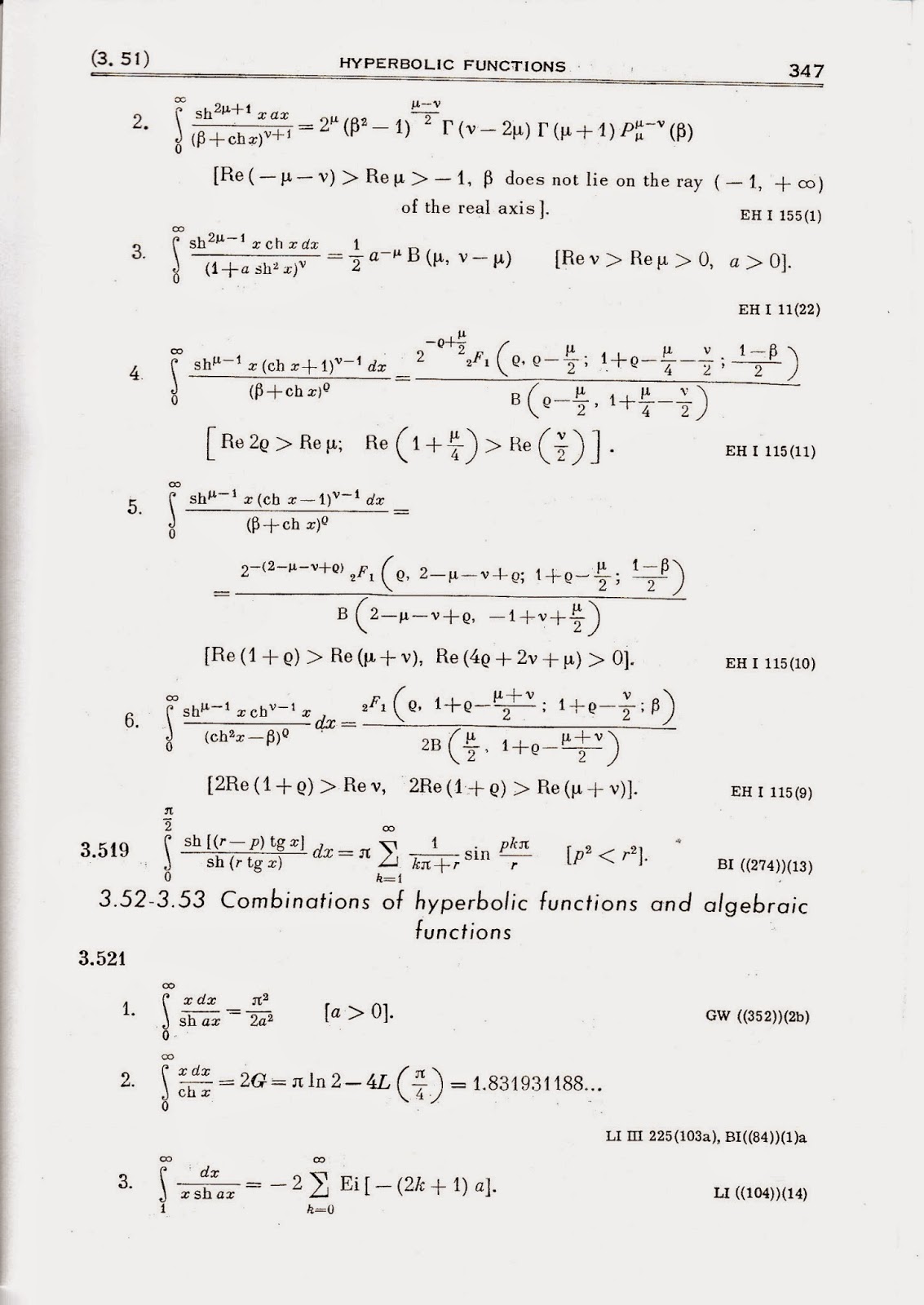
(Sample page)
 is now in its 8th edition (2014). You can download the 7th ed. (2007) on a pay-by-the-chapter basis from here, and you should be aware of the associated errata document.
Tuesday, April 14, 2015
Regression Coefficients & Units of Measurement
A linear regression equation is just that - an equation. This means that when any of the variables - dependent or explanatory - have units of measurement, we also have to keep track of the units of measurement for the estimated regression coefficients.
All too often this seems to be something that students of econometrics tend to overlook.
Consider the following regression model:
yi = β0 + β1X1i + β2x2i + β3x3i + εi ; i = 1, 2, ...., n (1)
where y and x2 are measured in dollars; x1 is measured in Kg; and x3 is a unitless index.
Because the term on the left side of (1) has units of dollars, every term on the right side of that equation must also be expressed in terms of dollars. These terms are β0, (β1x1i), (β2x2i), (β3x3i), and εi.
In turn, this implies that β0 and β3 have units which are dollars; the units of β1 are ($ / Kg); and β2 is unitless. In addition, the error term, ε, has units that are dollars, and so does its standard deviation, σ.
What are some of the implications of this?
Sunday, April 12, 2015
How (Not) to Interpret That p-Value
Thanks to my colleague, Linda Welling, for bringing this post to my attention: Still Not Significant.
I just love it!
(Take some of the comments with a grain of salt, though.)
Tuesday, April 7, 2015
Question from a Reader
Recently, I received an email from Ozan, who wrote:
"I’ve a simple but not explicitly answered question within the text books on stationary series. I’m estimating a model with separate single equations (I don’t take into account the interactions among them ). I’ve only non-stationary series in some equations (type 1), only stationary in some (type 2), and a combination of the both in the others (type 3). For the first two cases I apply the usual procedures and for the last case the Pesaran (2011) test. I want to find the short term effects of some variables on the others. I’ve two questions:
1) If the Pesaran test turns out inconclusive or rejects cointegration, what’s the next step ? Differencing all the series and applying an OLS? Or differencing only the non-stationary ones? Or another method?
2) As I mentioned I’m looking for the short-run effects. In the type 2 equations, I guess running an OLS in levels gives the long-run effects. Therefore I run an OLS in differences. Some claim that differencing an already stationary series causes problems. I’m confused. What do you think?"
Let's start out by making sure what Ozan means by "the usual procedures" for his "Type 1" and "Type 2" equations.
Saturday, April 4, 2015
Inside the Econometric Game
Now that the Econometric Game, 2015 is over I can reveal the cases that the teams grappled with. The Case Makers were Bas Werker and Ramon van den Akker, both of Tilburg University.
You'll recall that thirty teams, from various parts of the world, played The Game this year. On Day 1, the teams received information about the topic, together with the data and the papers that they should read by way of preparation. As I mentioned here, the topic was "Longevity and Longevity Risk".
On Day 2, the competition began in earnest, with the teams being challenged with Case 1.
The top ten teams from Day 2 then moved to the final part of the competition. This involved working on Case 2 on the third day of The Game.
Now, what about the cases themselves?
Friday, April 3, 2015
And the Winners Are............
The results of the Econometric Game (AKA The World Championship of Econometrics) were decided in Amsterdam yesterday.
Here are the results for the 2015 competition:
First Place - Maastricht University
Second Place - University of Illinois at Urbana-Champaign
Third Place - Harvard University
Congratulations to each of these teams, and to all of the competing teams for a great event!
In her daily report to me, Nikki mentioned that the judges were unanimous about the placings, and she also commented that "...we are really happy that a Dutch team won."
I'll be following up with a final wrap-up post.
Subscribe to:
Posts (Atom)