Showing posts with label Consumer demand. Show all posts

Monday, July 2, 2018

Some Reading Suggestions for July

Some summertime reading:
  • Chen, T., DeJuan, J., & R. Tian, 2018. Distributions of GDP across versions of  the Penn World Tables: A functional data analysis approach. Economics Letters, in press. 
  • Clements, K.W., H. Liu, & Y. Tarverdi, 2018. Alcohol consumption, censorship and misjudgment. Applied Economics, online
  • Jin, H., S. Zhang, J. Zhang,& H. Hao, 2018. Modified tests for change points in variance in the possible presence of mean breaks. Journal of Statistical Computation and Simulation, online
  • Pata, U.K., 2018. The Feldstein Horioka puzzle in E7 countries: Evidence from panel cointegration and asymmetric causality analysis. Journal of International Trade and Economic Development, online.
  • Sen, A., 2018. A simple unit root testing methodology that does not require knowledge regarding the presence of a break. Communications in Statistics - Simulation and Computation, 47, 871-889.
  • Wright, T., M. Klein, &K. Wieczorek, 2018. A primer on visualizations for comparing populations, including the issue of overlapping confidence intervals. American Statistician, online.

© 2018, David E. Giles

Saturday, February 10, 2018

Economic Goodness-of-Fit

What do we mean by a "significant result" in econometrics?

The distinction between "statistical significance" and "economic significance" has received a good deal of attention in the literature. And rightly so.

Think about the estimated coefficients in a regression model, for example. Putting aside the important issue of the choice of a significance level when considering statistical significance, we all know that results that are significant in the latter sense may or may not be 'significant' when their economic impact is considered.

Marc Bellemare provided a great discussion of this in his blog a while back.

Here, I want to draw attention to a somewhat related issue - distinguishing between the statistical and economic overall goodness-of-fit of an economic model.

Tuesday, October 13, 2015

Angus Deaton, Consumer Demand, & the Nobel Prize

I was delighted by yesterday's announcement that Angus Deaton has been awarded the Nobel Prize in Economic Science this year. His contributions have have been many, fundamental, and varied, and I certainly won't attempt to summarize them here. Suffice to say that the official citation says that the award is "for his contributions to consumption, poverty, and welfare".

In this earlier post I made brief mention of Deaton's path-breaking work, with John Muellbauer, that gave us the so-called "Almost Ideal Demand System". 

The AIDS model took empirical consumer demand analysis to a new level. It facilitated more sophisticated, and less restrictive, econometric analysis of consumer demand behaviour than had been possible with earlier models. The latter included the fundamentally important Linear Expenditure System (Stone, 1954), and the Rotterdam Model (Barten, 1964; Theil, 1965).

I thought that readers may be interested in an empirical exercise with the AIDS model. Let's take a look at it. 

Thursday, August 6, 2015

Estimating Elasticities, All Over Again

I had some interesting email from Andrew a while back to do with computing elasticities from log-log regression models, and some related issues.

In his first email, Andrew commented:
"I am interested in the elasticity of H with respect to W, e.g., hours with respect to wages. For simplicity, assume that W is randomly assigned, and that the elasticity is identical for everyone.
Standard practice would be to regress log(H) on a constant and log(W). The coefficient on log(W) then seems to be the elasticity, as it estimates d log(H) / d log(W).
But changes in log( ) are only equal to changes in percent in the limit as the changes go to zero. In practice, one typically uses discrete data. Because the changes in W may be large, the resulting coefficient is just a first order approximation of the elasticity, and is not identical to the true elasticity."
Let's focus on the third paragraph. Keep in mind that log( ), here, refers to "natural" (base 'e') logarithms.

Andrew is quite correct, and this is something that we often overlook when teaching econometrics, or when interpreting someone's regression results. I sometimes refer students to this useful piece by Kenneth Benoit. Here's a key extract from p.4:

Tuesday, June 2, 2015

June Reading List


  • Andrews, I. and T. B. Armstrong, 2015. Unbiased instrumental variables estimation under known first-stage sign. Cowles Foundation Discussion Paper No. 1984R, Yale University,
  • Bajari, P., D. Nekipelov, S. P. Ryan, and M. Yang. 2015. Demand estimation with machine learning and model combination. NBER Working Paper 20955.
  • Chambers, M. J., 2015. A jackknife correction to a test for cointegration rank. Econometrics, 3, 355-375.
  • Mazeu, J. H. G., E. Ruiz and H. Veiga, 2015. Model uncertainty and the forecast accuracy of ARMA models: A survey. UC3M Working Paper 15-08, Statistics and Econometrics, Universidad Carlos III de Madrid. 
  • Paldam, M., 2015. Meta-analysis in a nutshell: Techniques and general findings. Economics, 9, 2015-11.
  • Triacca, U., 2015. A pitfall in using the characterization of Granger non-causality in vector autoregressive models. Econometrics, 3, 233-239.

© 2015, David E. Giles

Saturday, February 28, 2015

March Reading List

Good grief! It's March already. You might enjoy:

Bajari, P., D. Nekipelov, S. P. Ryan, and M. Yang, 2015. Demand estimation with machine learning and model combination. NBER Working Paper No, 20955.

Baur, D. G. and D. T. Tran, 2014. The long-run relationship of gold and silver and the influence of bubbles and financial crises. Empirical Economics, 47, 1525-1541.

Efron, B., 2014. Estimation and accuracy after model selection. Journal of the American Statistical Association, 109, 991-1007.

Kennedy, P. E., 1995. Randomization tests in econometrics. Journal of Business and Economic Statistics, 13, 85-94.

Magnus, J. R., W. Wang, and X. Zhang, 2015. Weighted-average least squares prediction. Econometric Reviews, in press.

Osman, A. F. and M. L. King, 2015. A new approach to forecasting based on exponential smoothing with independent regressors. Working Paper 02/15, Department of Econometrics and Business Statistics, Monash University.

Perron, P. and Y. Yamamoto, 2015. Using OLS to estimate and test for structural change in models with endogenous regressors. Journal of Applied Econometrics, 30, 119-144.

© 2015, David E. Giles

Sunday, December 14, 2014

The Rotterdam Model

Ken Clements (U. Western Australia) has sent me a copy of his paper, co-authored with Grace Gao this month, "The Rotterdam Demand Model Half a Century On". 

How appropriate it is to see this important landmark in econometrics honoured in this way. And how fitting that this paper is written by two Australian econometricians, given the enormous contributions to empirical demand analysis that have come from that group of researchers - including Ken and his many students - over the years. (But more on this another time.)

Any student who wants to see applied econometrics at its best can do no better than look at the rich empirical literature on consumer demand. That literature will take you beyond the "toy" models that you meet in your micro. courses, to really serious ones: the Linear Expenditure System, the Rotterdam Model, the Almost Ideal Demand System, and others. Where better to see the marriage of sound economic modelling, interesting data, and innovative statistical methods? In short - "econometrics".

Back to Ken and Grace's paper, though. Here's the abstract:

Sunday, November 16, 2014

Orthogonal Regression: First Steps

When I'm introducing students in my introductory economic statistics course to the simple linear regression model, I like to point out to them that fitting the regression line so as to minimize the sum of squared residuals, in the vertical direction, is just one possibility.

They see, easily enough, that squaring the residuals deals with the positive and negative signs, and that this prevents obtaining a "visually silly" fit through the data. Mentioning that one could achieve this by working with the absolute values of the residuals provides the opportunity to mention robustness to outliers, and to link the discussion back to something they know already - the difference between the behaviours of the sample mean and the sample median, in this respect.

We also discuss the fact that measuring the residuals in the vertical ("y") direction is intuitively sensible, because the model is purporting to "explain" the y variable. Any explanatory failure should presumably be measured in this direction. However, I also note that there are other options - such as measuring the residuals in the horizontal ("x") direction.

Perhaps more importantly, I also mention "orthogonal residuals". I mention them. I don't go into any details. Frankly, there isn't time; and in any case this is usually the students' first exposure to regression analysis and they have enough to be dealing with. However, I've thought that we really should provide students with an introduction to orthogonal regression - just in the simple regression situation - once they've got basic least squares under their belts. 

The reason is that orthogonal regression comes up later on in econometrics in more complex forms, at least for some of these students; but typically they haven't seen the basics. Indeed, orthogonal regression is widely used (and misused - Carroll and Ruppert, 1966) to deal with certain errors-in-variables problems. For example, see Madansky (1959).

That got me thinking. Maybe what follows is a step towards filling this gap.

Thursday, November 6, 2014

The Village Idiot Hypothesis

Yesterday, I received an email from Michael Belongia (Economics, U. Mississippi). With it, he kindly sent a copy of the Presidential Address to the American Agricultural Economics Association in 1979. The talk, given by Richard A. King, was titled "Choices and Consequences". It makes interesting reading, and many of the points that King makes are just as valid today as they were in 1979.

He has a lot to say about empirical consumer demand studies, especially as they relate to agricultural economics. In particular, he's rightly critical of the very restrictive characteristics of the Linear Expenditure System (Stone, 1954), and the Rotterdam Model (Theil, 1975). However, many of the objections that King raised were overcome just a year later with the "Almost Ideal Demand System" introduced by Deaton and Muellbauer (1980). 

However, it was my recent post on hypothesis testing that prompted Michael to email me, and King makes some telling observations on this topic in his address.

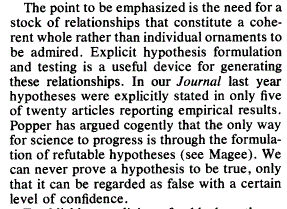
I liked this remark about the need to be explicit about the hypotheses that we have in mind when undertaking empirical work:


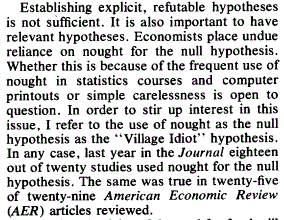
King also talks about "The Village Idiot Hypothesis", in relation to the preoccupation with testing hypotheses such as β = 0. 


As Michael said to me in his email, "When, as in one example, decades of research have indicated that some elasticity is -0.2, why do new papers test whether β = 0 rather than β = -0.2?"

If you have access to the American Journal of Agricultural Economics, I recommend that you take a look at Richard King's address, as he makes several other important points that practitioners should take to heart.


References


King, R. A., 1979. Choices and consequences. American Journal of Agricultural Economics, 61, 839-848.

Deaton, A. and J. Muellbauer, 1980. An almost ideal demand system. American Economic Review, 70, 312-326.

Stone, R.1954. Linear expenditure systems and demand analysis: An application to the pattern of British demand".Economic Journal, 64, 511-527.

Theil, H., 1975. Theory and Measurement of Consumer Demand, Vol. 1. North-Holland, Amsterdam.


© 2014, David E. Giles

Thursday, July 17, 2014

Demand Analysis, Henry Schultz and the Rediscovery of Slutsky

Empirical demand analysis played a central role in the early history of econometrics. For instance, studies relating to this topic laid the groundwork for our understanding of simultaneous equations systems, identification, and instrumental variables estimation.

Throughout the 1950's, 1960's, and 1970's, empirical demand analysis loomed large in the empirical econometrics literature. So, any new insights relating to the history of the theory of demand are of considerable interest to applied econometricians.

Olav Bjerkholt, of the Department of Economics at the University of Oslo, has recently released a paper titled, "Henry Schultz and the Rediscovery of Slutsky (1915)". Here's the abstract:

Wednesday, February 12, 2014

Bayesian Model Selection - A Worked Example

Choosing between non-nested models can be challenging. A lot of statisticians and econometricians find that a Bayesian approach has a lot to offer when it comes to addressing this challenge. I'm certainly of that view myself.

Let me take you through an empirical example of Bayesian model selection - it involves alternative regression models for the demand for beer in Australia - and it's one that I use, sometimes, in class.

Friday, November 1, 2013

Some Weekend Reading

Just what you need - some more interesting reading!
  • Al-Sadoon, M. M., 2013. Geometric and long run aspects of Granger causality. Mimeo., Universitat Pompeu Fabra. (Forthcoming in Journal of Econometrics.)
  • Barnett, W. A. and I. Kalondo-Kanyama, 2013. Time-varying parameter in the almost ideal demand system and the Rotterdam model: Will the best specification please stand up? Working Paper 335, Econometric Research Southern Africa.
  • Delgado, M. S. and C. F. Parmenter, 2013, Embarrassingly easy embarrassingly parallel processing in R. Journal of Applied Econometrics, early view, DOI: 10.1002/jae.2362 .
  • Doko Tchatoka, H., 2013. On bootstrap validity for specification tests with weak instruments. Discussion Paper 2013-05, School of Economics and Finance, University of Tasmania.
  • Fisher, L. A., H-S. Huh, and A. R. Pagan , 2013, Econometric issues when modelling with a mixture of I(1) and I(0) variables. NCER Working Paper Series, Working Paper #97.
  • Pesaran, H. H. and Y. Shin, 1998. Generalized impulse response analysis in linear multivariate models. Economics Letters, 58, 17-29.
  • Warr, R. L. and R. A. Erich, 2013. Should the interquartile range divided by the standard deviation be used to assess normality? American Statistician, online, 
    DOI:
    10.1080/00031305.2013.847385 .
  • Zhang, X. and X. Shao, 2013, On a general class of long run variance estimators. Economics Letters, 120, 437-441.

© 2013, David E. Giles

Monday, August 26, 2013

From My Reading List...........

Here are a few of the papers that I've been reading over the past week or so:
  • Amisano, G. and J. Geweke, 2013. Prediction using several macroeconomic models.Working Paper Series NO. 1357, European Central Bank.
  • Arnold, B. C. and H. K. T. Ng, 2011. Flexible bivariate beta distributions. Journal of Multivariate Analysis, 102, 1194-1202.
  • Johansen, S. and B. Nielsen, 2013.  Outlier detection in a regression using an iterated one-step approximation to the Huber-skip estimator. Econometrics, 1, 53-70.
  • Magnus, J. R. and A. L. Vasnev, 2013. Practical use of sensitivity in econometrics with an illustration to forecast combinations. B. A. Working Paper No. 04/2013, The University of Sydney Business School, University of Sydney.
  • Pendakur, K. and S. Sperlich, 2010. Semiparametric estimation of consumer demand systems in real expenditure. Journal of Applied Econometrics, 25, 420-457.
  • Solon, G, S. J. Haider, and J. Wooldridge, 2013. What are we weighting for? Working Paper 18859. National Bureau of Economic Research.

© 2013, David E. Giles

Friday, August 2, 2013

Allocation Models With Autocorrelated Errors

Not too long ago, I had a couple of posts about "allocation models" (here and here). These models are systems of regression equations in which there is a constraint on the data for the dependent variables for the equations. Specifically, at every point in the sample, these variables sum exactly to the value of a linear combination of the regressors. In practice, this linear combination usually is very simple - it's just one of the regressors.

So, for example, suppose that the dependent variables measure the shares of Canada's exports that go to different countries. These shares must add up to one in value. If we have an intercept (a series of "ones") in each equation, then we have an allocation model.

In one of the comments on the earlier posts, I was asked about the possibility of autocorrelated errors in the empirical example that I provided. In my response, I noted that if autocorrelation is present, and is allowed for in the estimation of the model, then special care is needed. In particular, any modification to the model, to allow for a specific form of autocorrelation, must satisfy the "adding up" constraints that are fundamental to the allocation model.

Let's see what this involves, in practice.

Monday, July 29, 2013

Recent, and Recommended.......

Recently, I griped posted about the need to get the economics back into papers that the authors characterize as "microeconometrics". Although I was venting (just a little!) about the "disconnect" that we so often see, between the theory section and the empirical section, in so many of the papers in this category, I also commented that there are plenty of papers out there that avoid this disconnect. I just wish there were more of them!

In response to one of the comments of that post, I gave just one such example, and afterwards I thought that although my choice was a good one, it was somewhat dated. So, on a more positive note, what about some recent papers that exemplify what I'm looking for, and what I'd like to see more of?

Sunday, July 14, 2013

Vintage Years in Econometrics - The 1950's

Following on from my earlier posts about vintage years for econometrics in the 1930's and 1940's, here's my run-down on the 1950's.

As before, let me note that "in econometrics, what constitutes quality and importance is partly a matter of taste - just like wine! So, not all of you will agree with the choices I've made in the following compilation."

Thursday, July 11, 2013

Let's Put the "ECON" Back Into Microeconometrics

You just couldn't resist the title, could you?

Don't worry, I'm not going to be too harsh. After all, I'm rather fond of those who practise "applied microeconometrics" - especially lightly sautéed, with a little pepper and garlic. Sorry! Sorry!

The point that I want to make is a simple one, and I'll be brief.

How many seminars have you attended where the speaker has gone through the details of a formal microeconomic model, and then proceeded to a potentially interesting empirical application? And in how many cases was there a total "disconnect" between the theoretical model and the empirical model?

Hand up! Don't be shy! Wow - that's almost everyone!

Friday, July 5, 2013

Allocation Models With Bounded Dependent Variables

My post yesterday, on Allocation Models, drew a comment to the effect that in such models the dependent variables take values that must to be non-negative fractions. Well, as I responded, that's true sometimes (e.g., in the case of market shares); but not in other cases- such as the Engel curve example that I mentioned in the post.

The anonymous comment was rather terse, but I'm presuming that the point that was intended is that if the y variables have to be positive fractions, we wouldn't want to use OLS. Ideally, that's so. Of course, we could use OLS and then check that all of the within-sample predicted values are between zero and one. Better still, we could use a more suitable estimator - one that takes the restriction on the data values into account.

The obvious solution is to assume that the errors, and hence the y values, follow a Beta distribution, and then estimate the equations by MLE. As I noted in my response to the comment, the "adding up" restictions that are needed on the parameters will be satisfied automatically, just as they are under OLS estimation.

Here's a demonstration of this.

Thursday, July 4, 2013

Allocation Models

An "allocation model" is a special type of multi-equation model that has some interesting properties. This type of model arises quite frequently in applied econometrics, and it's worth knowing about it. In this post I'll explain what an allocation model is, and explore some of the estimation results that arise.

Tuesday, July 2, 2013

N.Z. Association of Economists Conference

Although it's still the afternoon of Tuesday 2 July here on the We(s)t Coast, it's already the morning of Wednesday 3 July in New Zealand. That being the case, the 54th Annual Conference of the New Zealand Association of Economists is just getting underway in Wellington. Although I'm not attending, I do have a soft-spot for this conference, and I'll be participating next year.

The conference program includes a number of interesting looking empirical papers, and as usual there is a strong emphasis on economic policy analysis.

The other reason for my interest in this conference? The first conference paper I ever presented was at the 1972 NZAE Conference, held at Massey University in Palmerston North. I talked about "Consumption Expenditure in New Zealand". How time flies!


© 2013, David E. Giles