Showing posts with label Replication. Show all posts

Sunday, May 19, 2019

Update on the "Series of Unsurprising Results in Economics"

In June of last year I had a post about a new journal, Series of Unsurprising Results in Economics (SURE).

If you didn't get to read that post, I urge you to do so. 

More importantly, you should definitely take a look at this piece by Kelsey Piper, from a couple of days ago, and titled, "This economics journal only publishes results that are no big deal - Here’s how that might save science".

Kelsey really understands the rationale for SURE, and the important role that it can play in terms of reducing publication bias, and assisting with replicating results.

You can get a feel for what SURE has to offer by checking out this paper  by Nick Huntington-Klein and Andrew Gill that they are publishing.

We'll all be looking forward to more excellent papers like this!

© 2019, David E. Giles

Wednesday, October 3, 2018

A Shout-Out for The Replication Network

In May 2015 I posted about the newly-formed The Replication Network (TRN). Since then, their team has been extremely busy promoting and fostering their objectives to serve "...... as a channel of communication to (i) update scholars about the state of replications in economics, and (ii) establish a network for the sharing  of information and ideas." TRN's "..... goal is to encourage economists and their journals to publish replications."

And they're doing a great job!

As a member of TRN I receive email newsletters from them regularly. I thought I'd share the one that I received this morning, in the hope that it might encourage some of you to become TRN members.

Here it is:

Wednesday, June 6, 2018

The Series of Unsurprising Results in Economics (SURE)

Andrea Menclover of the University of Canterbury (New Zealand) has recently founded the SURE Journal, whose aims and scope are as follows:

'The Series of Unsurprising Results in Economics (SURE) is an e-journal of high-quality research with “unsurprising” findings. We publish scientifically important and carefully-executed studies with statistically insignificant or otherwise unsurprising results. Studies from all fields of Economics will be considered. SURE is an open-access journal and there are no submission charges. (My emphasis, DG.)

SURE benefits readers by:
  • Mitigating the publication bias and thus complementing other journals in an effort to provide a complete account of the state of affairs;
  • Serving as a repository of potential (and tentative) “dead ends” in Economics research.

SURE benefits writers by:
  • Providing an outlet for interesting, high-quality, but “risky” (in terms of uncertain results) research projects;
  • Decreasing incentives to data-mine, change theories and hypotheses ex post or exclusively focus on provocative topics.'

To find out more or to submit a manuscript, visit: http://surejournal.org.

This is a novel venture that has a lot to offer at a time when research replicability and publication bias are (rightly) receiving so much attention.

I'm delighted to be associated with the new journal as a member of its Editorial Board.

© 2018, David E. Giles

Sunday, November 5, 2017

Econometrics Reading List for November

Some suggestions........

  • Garcia, J. and D. E. Ramirez, 2017. The successive raising estimator and its relation with the ridge estimator. Communications in Statistics - Theory and Methods, 46, 11123-11142.
  • Silva, I. R., 2017. On the correspondence between frequentist and Bayesian tests. Communications in Statistics - Theory and Methods, online.
  • Steel, M. F. J., 2017. Model averaging and its use in economics. MPRA Paper No. 81568.
  • Teräsvirta, T., 2017. Nonlinear models in macroeconometrics. CREATES Research Paper 2017-32.
  • Witmer, J., 2017. Bayes and MCMC for undergraduates. American Statistician, 71, 259-274.
  • Zimmerman, C., 2015. On the need for a replication journal. Federal Reserve Bank of St. Louis, Working Paper 2015-016A.
© 2017, David E. Giles

Sunday, October 22, 2017

Another Shout-Out for The Replication Network

Replication in empirical economics is vitally important, and I'm delighted to be a member of The Replication Network. I've mentioned this group in previous blog posts - for instance, here and here.

The list of members of TRN continues to grow - why not consider becoming a member your self? Here's the link that you need to do so. 

The TRN website includes some excellent guest blog posts, the latest of which is about a new journal dedicated to the replication of economic research. The post is by  Martina Grunow, the Managing Editor of the International Journal for Re-Views in Empirical Economics (IREE).

If you haven't checked out TRN, why not do so - and why not join?

© 2017, David E. Giles

Sunday, September 10, 2017

Econometrics Reading List for September

A little belatedly, here is my September reading list:
  • Benjamin, D. J. et al., 2017. Redefine statistical significance. Pre-print.
  • Jiang, B., G. Athanasopoulos, R. J. Hyndman, A. Panagiotelis, and F. Vahid, 2017. Macroeconomic forecasting for Australia using a large number of predictors. Working Paper 2/17, Department of Econometrics and Business Statistics, Monash University.
  • Knaeble, D. and S. Dutter, 2017. Reversals of least-square estimates and model-invariant estimations for directions of unique effects. The American Statistician, 71, 97-105.
  • Moiseev, N. A., 2017. Forecasting time series of economic processes by model averaging across data frames of various lengths. Journal of Statistical Computation and Simulation, 87, 3111-3131.
  • Stewart, K. G., 2017. Normalized CES supply systems: Replication of Klump, McAdam and Willman (2007). Journal of Applied Econometrics, in press.
  • Tsai, A. C., M. Liou, M. Simak, and P. E. Cheng, 2017. On hyperbolic transformations to normality. Computational Statistics and Data Analysis, 115, 250-266,


© 2017, David E. Giles

Thursday, January 5, 2017

Reproducible Research in Statistics & Econometrics

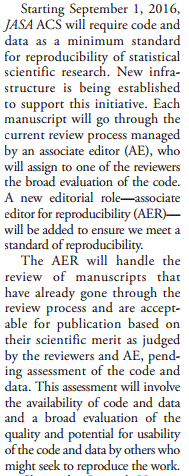
The American Statistical Association has recently introduced reproducibility requirements for articles published in its flagship journal, The Journal of the American Statistical Association.

The following is extracted from p.17 of the July 2016 issue of Amstat News:


Coming from one of the most prestigious statistics journals, this is good news for everyone!

We could do with more of this in the econometrics journals, and in those economics journals that publish empirical studies. 

To that end, I again commend The Replication Network.


© 2017, David E. Giles

Thursday, December 29, 2016

Why Not Join The Replication Network?

I've been a member of The Replication Network (TRN) for some time now, and I commend it to you.

I received the End-of-the-Year Update for the TRN today, and I'm taking the liberty of reproducing it below in its entirety in the hope that you may consider getting involved.

Here it is:

Friday, September 9, 2016

Spreadsheet Errors

Five years ago I wrote a post titled, "Beware of Econometricians Bearing Spreadsheets". 

The take-away message from that post was simple: there's considerable, well-documented, evidence that spreadsheets are very, very, dangerous when it comes to statistical calculations. That is, if you care about getting the right answers!

Read that post, and the associated references, and you'll see what I mean.

(You might also ask yourself, why would I pay big bucks for commercial software that is of questionable quality when I can use high-quality statistical software such as R, for free?)

This week, a piece in The Economist looks at the shocking record of publications in genomics that fall prey to spreadsheet errors. It's a sorry tale, to be sure. I strongly recommend that you take a look.

Yes, any software can be mis-used. Anyone can make a mistake. We all know that. However, it's not a good situation when a careful and well-informed researcher ends up making blunders just because the software they trust simply isn't up to snuff!  


© 2016, David E. Giles

Tuesday, February 9, 2016

The Replication Network

This is a "shout out" for The Replication Network.

The full name is, The Replication Network: Furthering the Practice of Replication in Economics. I was alerted to TRN some time ago by co-organiser, Bob Reed, and I'm pleased to be a member.

What's TRN about:
"This website serves as a channel of communication to (i) update scholars about the state of replications in economics, and (ii) establish a network for the sharing  of information and ideas. 
The goal is to encourage economists and their journals to publish replications."
There's News & Events; Guest Blogs; Research involving replications in economics; and lots more.

Hats off to TRN. We need more of this!

© 2016, David E. Giles

Thursday, May 28, 2015

The Replication Network

Some of my previous posts have dealt with the issue of replicability - e.g., here and here.

I had an email from Bob Reed today, alerting me to his involvement in the launching of The Replication Network. I knew that this was a big interest of Bob's, and it's great to see where things are going with this important venture.

Here's Bob's email:
"I would like to invite you to consider joining The Replication Network (TRN). TRN is a website/community of scholars committed to promoting the use of replications in economics.  For those of you who have seen an earlier version of the website, please note that the site has been thoroughly revamped in preparation for its “rollout” in June 2015.  I think you will like what you see.  You can check it out at :http://replicationnetwork.com/. For researchers interested in publishing replication studies, the website provides up-to-date information about (i) which journals encourage replication submissions, and (ii) a list of recently published replication studies that can serve as models of good practice.  It also lists News and Events related to replications. Membership has its privileges. :-)  Members can post their research on the website and are invited to contribute guest blogs related to replications.  Members will also receive email updates every few months alerting them to new content on the website. There is no financial cost to join TRN, you will not be bothered with advertising or other spam, and you can easily unsubscribe if you later choose to.  The main reason I encourage you to join TRN is because there is strength in numbers.  If journals can see that there is a substantial readership of academics who support replication research and are interested in seeing it promoted, they may choose to change their editorial policies to include the publishing of replication studies.  The lack of publishing outlets is the single biggest obstacle to the wider use of replication in economics. 
Thank you for giving this some thought. And feel free to forward this email to your colleagues. 
If you have any questions do not hesitate to contact me."

I hope that readers will check this out and spread the word.


© 2015, David E. Giles

Saturday, January 31, 2015

Some Suggested Reading

  • Bahoc, F., H. Leeb, and B. M. Potscher, 2014. Valid confidence intervals for post-model-selection predictors. Working Paper, Department of Statistics, University of Vienna.
  • Baumeister, C. and J. D. Hamilton, 2014. Sign restrictions, structural vector autoregressions, and useful prior information. NBER Working Paper No. 20741.
  • Bjerkholt, O., 2015. Fellowship elections in the Econometric Society 1933-1948. Working Paper, Department of Economics, University of Oslo.
  • Deuchert, E. and M. Huber, 2014. A cautionary tale about control variables in IV estimation. Discussion Paper No. 2014-39, School of Economics and Political Science, University of St. Gallen.
  • Doornik, J. A. and D. F. Hendry, 2014. Statistical model selection with 'Big Data'. Discussion Paper 735, Department of Economics, University of Oxford.
  • Duendack, M., R. W. Palmer-Jones, and W. R. Reed, 2014. Replications in economics: A progress report. Working Paper No. 26/2014, Department of Economics and Finance, University of Canterbury.

© 2015, David E. Giles

Friday, May 9, 2014

Replication in Economics

I was pleased to receive an email today, alerting me to the "Replication in Economics" wiki at the University of Göttingen:
"My name is Jan H. Höffler, I have been working on a replication project funded by the Institute for New Economic Thinking during the last two years and found your blog that I find very interesting. I like very much that you link to data and code related to what you write about. I thought you might be interested in the following:
 
We developed a wiki website that serves as a database of empirical studies, the availability of replication material for them and of replication studies: http://replication.uni-goettingen.de

It can help for research as well as for teaching replication to students. We taught seminars at several faculties internationally - also in Canada, at UofT - for which the information of this database was used. In the starting phase the focus was on some leading journals in economics, and we now cover more than 1800 empirical studies and 142 replications. Replication results can be published as replication working papers of the University of Göttingen's Center for Statistics.

Teaching and providing access to information will raise awareness for the need for replications, provide a basis for research about the reasons why replications so often fail and how this can be changed, and educate future generations of economists about how to make research replicable.

I would be very grateful if you could take a look at our website, give us feedback, register and vote which studies should be replicated – votes are anonymous. If you could also help us to spread the message about this project, this would be most appreciated."
I'm more than happy to spread the word, Jan. I've requested an account, and I'll definitely be getting involved with your project. This look like a great venture!


© 2014, David E. Giles