Monday, November 11, 2013

Calling All Forecasters!

The 34th International Symposium on Forecasting will be held in Rotterdam between 29 June and 2 July, 2014. Full details can be found here

I participated in the 2010 Symposium, in San Diego. It was a great meeting, very well run, and with a fabulous program. Definitely recommended!


© 2013, David E. Giles

Sunday, November 10, 2013

Free EViews Tutorials

Free Eviews tutorials - but not from me, I'm afraid!

"Free" is good, and you should keep in mind that free introductory tutorials are indeed available from the distributors of the EViews package. You can find the details here.

You can even download all of the associated Powerpoint presentations, and data files, in a zip file. Nice!


© 2013, David E. Giles

Friday, November 8, 2013

The Econometric Game, 2014

Doesn't time fly. We must be having fun! It's time to start thinking about The Econometric Game once again - this time, the 2014 edition.

April  15 to 17 2014 are the dates to keep in mind, and once again Amsterdam will be the place to be. Apparently entries are rolling in!

More on this in due course.


© 2013, David E. Giles

The Stock Market Crash - VECM's & Structural Breaks

A few weeks ago, Roger Farmer kindly drew my attention to a recent paper of his - "The Stock Market Crash Really Did Cause the Great Recession" (here). To whet your appetites, here's the abstract:
"This note shows that a big stock market crash, in the absence of central bank intervention, will be followed by a major recession one to four quarters later. I establish this fact by studying the forecasting ability of three models of the unemployment rate. I show that the connection between changes in the stock market and changes in the unemployment rate has remained structurally stable for seventy years. My findings demonstrate that the stock market contains significant information about future unemployment."

Sunday, November 3, 2013

Specification Testing for Panel Data Models

Recently, I received a query from Rolf Lyneborg Lund who asked for references to material on specification testing in the context of panel data models. After I responded to Rolf. it occurred to me that these references might also be of interest to others.

Going beyond the standard Hausman test for random versus fixed effects, here are some general references that may be helpful:
  • Baltagi, B. H., 1998. Panel data methods. In A. Ullah and D. E. A. Giles (eds.), Handbook of Applied Economic Statistics, Marcel Dekker, New York.
  • Baltagi, B. H., 1999. Specification tests in panel data models using artificial regressions. Annales d'Économie et des Statistiques, 55-56, 277-298.
  • Lee, Y-J., 2005. Specification testing for functional forms in dynamic panel data models.
  • Metcalf, G. E., 1996. Specification testing in panel data with instrumental variables. Journal of Econometrics, 71, 291-307.
  • Park, H. M., 2011. Practical guides to panel data modeling: A step by step analysis using stata. Public Management and Policy Analysis Program, Graduate School of International Relations, International University of Japan.
In addition, there's quite an extensive literature on testing for unit roots and cointegration in panel data models. I won't attempt to summarize this literature here, but a useful, recent, summary is provided by:
  • Chen, M-Y., 2013. Panel unit root and cointegration tests. Mimeo., Department of Finance, National Chung Hsing University.


© 2013, David E. Giles

Friday, November 1, 2013

Some Weekend Reading

Just what you need - some more interesting reading!
  • Al-Sadoon, M. M., 2013. Geometric and long run aspects of Granger causality. Mimeo., Universitat Pompeu Fabra. (Forthcoming in Journal of Econometrics.)
  • Barnett, W. A. and I. Kalondo-Kanyama, 2013. Time-varying parameter in the almost ideal demand system and the Rotterdam model: Will the best specification please stand up? Working Paper 335, Econometric Research Southern Africa.
  • Delgado, M. S. and C. F. Parmenter, 2013, Embarrassingly easy embarrassingly parallel processing in R. Journal of Applied Econometrics, early view, DOI: 10.1002/jae.2362 .
  • Doko Tchatoka, H., 2013. On bootstrap validity for specification tests with weak instruments. Discussion Paper 2013-05, School of Economics and Finance, University of Tasmania.
  • Fisher, L. A., H-S. Huh, and A. R. Pagan , 2013, Econometric issues when modelling with a mixture of I(1) and I(0) variables. NCER Working Paper Series, Working Paper #97.
  • Pesaran, H. H. and Y. Shin, 1998. Generalized impulse response analysis in linear multivariate models. Economics Letters, 58, 17-29.
  • Warr, R. L. and R. A. Erich, 2013. Should the interquartile range divided by the standard deviation be used to assess normality? American Statistician, online, 
    DOI:
    10.1080/00031305.2013.847385 .
  • Zhang, X. and X. Shao, 2013, On a general class of long run variance estimators. Economics Letters, 120, 437-441.

© 2013, David E. Giles

Tuesday, October 29, 2013

swirl: Learning Statistics & R

Most of us would acknowledge that getting up to speed with R involves a pretty steep learning curve - but it's worth every drop of sweat we shed in the process!

If you're learning basic statistics/econometrics, and learning R at the same time, then the challenge is two-fold. So, anything that will make this feasible (easy?) for students and instructors alike deserves to be taken very seriously.

Enter swirl - "statistics with interactive R learning" - developed at the Department of Biostatistics, Johns Hopkins University.  It's dead easy to download and install swirl - it just takes a few moments, and you're underway.

There are simple, interactive, lessons that introduce you to the essential concepts, and you have the option to watch related videos. If you need to take a break part way through a lesson then you can save what you've completed, and pick up from that point at a later time.

My guess is that students will find swirl appealing and very helpful.


© 2013, David E. Giles

Sunday, October 27, 2013

The Joys of Publishing!

I owe a VERY BIG hat-tip to Arthur Charpentier (he of the Freakonometrics blog) for alerting me to this one!

Getting your work published can pose interesting challenges at the best of times. But what about at the worst of times? 

Rick Trebino, of the School of Physics at Georgia Tech., tells us "How to Publish a Scientific Comment in 1 2 3 Easy Steps". I just love it!

Here's how Rick's story begins:

The Future of Statistical Sciences Workshop

No doubt you know, already, that 2013 has been the International Year of Statistics. To that end, there's been a veritable smorgasbord of activities and events promoting the discipline, and the contributions of statisticians far and wide.

The capstone event for Statistics2013 is "The Future of Statistical Sciences Workshop", to be held in London (England) on 11 and 12 November.

This workshop
"...will showcase the breadth and importance of statistics and highlight the extraordinary opportunities for statistical research in the coming decade.
This invitation-only workshop will be an opportunity for presenters, all statisticians and organizers to think about where statistics should go as a discipline and the lessons learned in the past that will guide us into the future. During this unique event, statistical scientists and scientists from other disciplines will interact and chart a shared vision for the future."
There are some great speakers lined up for this two-day event, and although the workshop is invitation-only, you can register now for the associated webinar.

And don't forget The Unconference on the Future of Statistics!
© 2013, David E. Giles

Saturday, October 26, 2013

Segmented Regression - Some (Relatively) Early References

In response to a recent post of mine on "segmented regression", an anonymous reader asked if I knew when such regressions first appeared in the literature. I'm not sure of the very first reference, but there was certainly an active literature on this by the mid 1960's.

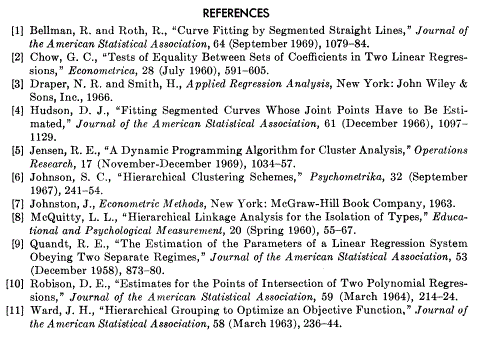
One good reference is V. E. McGee and W. T. Carleton (1970), "Piecewise Regression", Journal of the American Statistical Association, 65, 1109-1124. Those authors cite the following other material, which includes several earlier papers on this topic:

Hopefully, this is helpful.


© 2013, David E. Giles