Tuesday, April 14, 2015

Regression Coefficients & Units of Measurement

A linear regression equation is just that - an equation. This means that when any of the variables - dependent or explanatory - have units of measurement, we also have to keep track of the units of measurement for the estimated regression coefficients.

All too often this seems to be something that students of econometrics tend to overlook.

Consider the following regression model:

               yi = β0 + β1X1i + β2x2i + β3x3i + εi    ;    i = 1, 2, ...., n                   (1)

where y and x2 are measured in dollars; x1 is measured in Kg; and x3 is a unitless index.

Because the term on the left side of (1) has units of dollars, every term on the right side of that equation must also be expressed in terms of dollars. These terms are β0, (β1x1i), (β2x2i), (β3x3i), and εi.

In turn, this implies that β0 and β3 have units which are dollars; the units of β1 are ($ / Kg); and β2 is unitless. In addition, the error term, ε, has units that are dollars, and so does its standard deviation, σ.

What are some of the implications of this?

Sunday, April 12, 2015

How (Not) to Interpret That p-Value

Thanks to my colleague, Linda Welling, for bringing this post to my attention: Still Not Significant.

I just love it! 

(Take some of the comments with a grain of salt, though.) 


© 2015, David E. Giles

Tuesday, April 7, 2015

Question from a Reader

Recently, I received an email from Ozan, who wrote:
"I’ve a simple but not explicitly answered question within the text books on stationary series. I’m estimating a model with separate single equations (I don’t take into account the interactions among them ). I’ve only non-stationary series in some equations (type 1), only stationary in some (type 2), and a combination of the both in the others (type 3). For the first two cases I apply the usual procedures and for the last case the Pesaran (2011) test. I want to find the short term effects of some variables on the others. I’ve two questions: 
1) If the Pesaran test turns out inconclusive or rejects cointegration, what’s the next step ? Differencing  all the series and applying an OLS? Or differencing only the non-stationary ones? Or another method?
2) As I mentioned I’m looking for the short-run effects. In the type 2 equations, I guess running an OLS in levels gives the long-run effects. Therefore I run an OLS in differences. Some claim that differencing an already stationary series causes problems. I’m confused. What do you think?"
Let's start out by making sure what Ozan means by "the usual procedures" for his "Type 1" and "Type 2" equations.

Saturday, April 4, 2015

Inside the Econometric Game

Now that the Econometric Game, 2015 is over I can reveal the cases that the teams grappled with. The Case Makers were Bas Werker and Ramon van den Akker, both of Tilburg University.

You'll recall that thirty teams, from various parts of the world, played The Game this year. On Day 1, the teams received information about the topic, together with the data and the papers that they should read by way of preparation. As I mentioned here, the topic was "Longevity and Longevity Risk".

On Day 2, the competition began in earnest, with the teams being challenged with Case 1.

The top ten teams from Day 2 then moved to the final part of the competition. This involved working on Case 2 on the third day of The Game.

Now, what about the cases themselves?

Friday, April 3, 2015

And the Winners Are............

The results of the Econometric Game (AKA The World Championship of Econometrics) were decided in Amsterdam yesterday.

Here are the results for the 2015 competition:

First Place - Maastricht University

Second Place - University of Illinois at Urbana-Champaign

Third Place - Harvard University

Congratulations to each of these teams, and to all of the competing teams for a great event!

In her daily report to me, Nikki mentioned that the judges were unanimous about the placings, and she also commented that "...we are really happy that a Dutch team won."

I'll be following up with a final wrap-up post.


© 2015, David E. Giles

Wednesday, April 1, 2015

The Game Continues!

I'm pleased to be able to report on the events of the second day of The Econometric Game, 2015. Thanks, once again, to Nikki for providing the information for this post.

The end of Day 2 of the "Econometrics World Championships", today, saw the announcement of the ten teams that will go forward into the finals. Here they are:
  • Universidad Carlos III de Madrid
  • McGill University
  • University of Illinois at Urbana-Champaign
  • Harvard University
  • University of Amsterdam
  • Maastricht University
  • Aarhus University
  • University of Economics, Prague
  • University of Copenhagen
  • University of Antwerp
Great to see the McGill team doing well.

Nikki mentioned that there were loud cheers as each of the advancing teams was announced - especially in the case of the University of Copenhagen team (last year's winner). As you can see from the above list, they had to wait until nearly the end of the announcement before they knew their fate.

I also understand that the hosts (University of Amsterdam) are now in party mode - I bet they're not alone!

© 2015, David E. Giles

April Reading

April 1 already - time to update your reading list. Here are some suggestions:


© 2015, David E. Giles

Tuesday, March 31, 2015

Econometric Game 2015: Day 1

The Econometric Game, 2015, is underway!

Nikki Wesslius, a member of the organizing committee, has reported to me about the opening day of The Game, saying that it was a really hectic day. Apparently, all of the participants are really enthusiastic about the case study that will form the basis of the competition over the coming days.

Speakers at the opening of The Game included the CFO of Ortec (Gerrit Timmer) and Jan Pieter Balkenende (the former Dutch Prime Minister). Both of them talked about the social importance of econometrics. Among the remarks that were made was ‘Econometrics is the least known, most influential science’. 

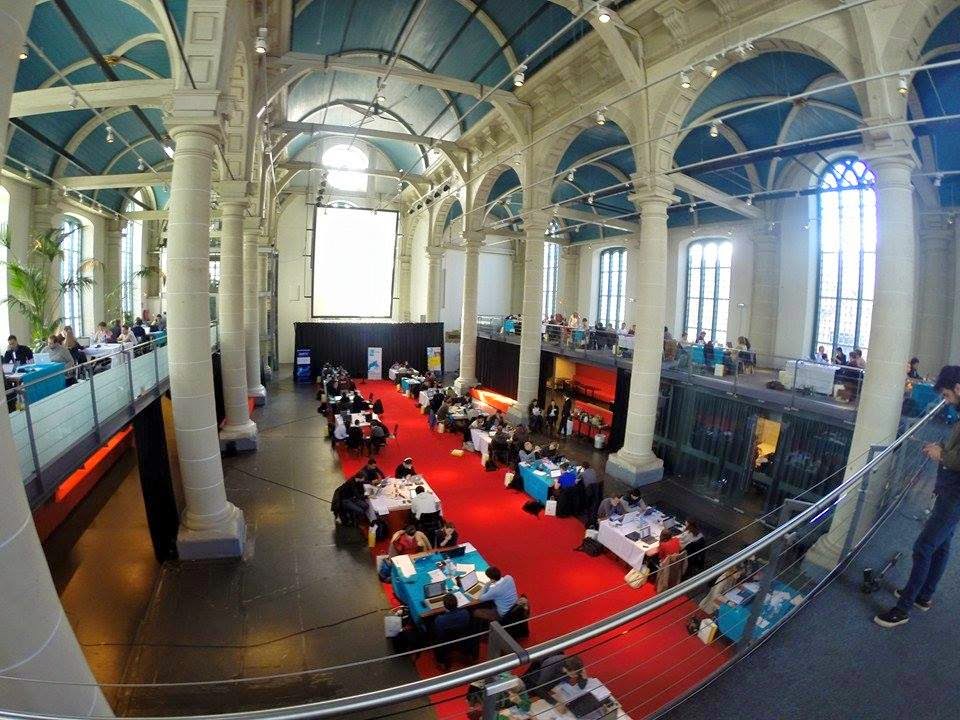
The location for The Game this year is the historic and beautiful Zuiderkerk (Southern Church) in Amsterdam. It was here that Rembrandt van Rijn stored his painting ‘Nachtwacht’ while he was working on it. 

Econometric Game Participants at the Zuiderkerk
The case study that forms the basis for The Game this year is titled "Longevity and Longevity Risk". Today, the thirty competing teams received only the articles and the data for the competition. Tomorrow morning they'll receive the exact case questions from the "case makers" for The Game, Bas Werker and Ramon van den Ekker (both of Tilburg University). 

We'll all be following their progress with great interest!


© 2015, David E. Giles

Monday, March 23, 2015

The World Championship of Econometrics!

Nikki Wesselius, a member of the Organizing Committee for the Econometric Game, 2015, has asked me to provide readers with information about this year's event. I'm delighted to do so,

The Econometric Game (AKA "The World Championship of Econometrics") is an exciting annual competition for econometrics students that I've had posts about in the past. (see here, here, here, and here.)

The 2015 EG begins in just a week from now, and here is the program:

Tuesday, March 31st 2015
09:00 - 09:30 Registration at ‘De Brug’ (The Bridge) at the REC University of Amsterdam
09:30 - 11:45 Opening at REC C1.04 the UvA
09:30 - 09:45 Wibrand de Reij (chairman EG committee)
09:45 - 10:00 Han van Dissel (dean UvA Faculty of Economics and Business)
10:00 - 10:25 EY J.P. Balkenende (former minister-president of the Netherlands)
10:25 - 10:40 Coffee and tea break
10:40 - 11:05 ORTEC Gerrit Timmer
11:05 - 11:45 Introduction to the case by the Casemakers
11:45 - 12:30 Lunch at CREA at the REC University of Amsterdam
13:00 - 18:00 Working on the Case at the Zuiderkerk
13:00 - 13:45 Introduction to the Case
18:30 - 21:00 Dinner at Chicanos

Wednesday, April 1st 2015
09:00 - 18:30 Working on the Case at the Zuiderkerk
09:00 - 09:15 Speech of the casemaker at the Zuiderkerk
12:00 - 13:00 Working lunch
19:00 - 21:30 Dinner at Brasserie Harkema
21:30 - 03:00 Drinks at Heeren van de Amstel (?)
21:30 - 22:00 Speech of Luke Disney
22:00 - 22:15 Announcement of the finalists

Thursday, April 2nd 2015
Finalists
08:30 - 17:00 Working on the Case at the Zuiderkerk
8:30 - 08:45 Speech of the casemaker at the Zuiderkerk
11:30 - 12:30 Working lunch
Non-finalists
11:00 - 14:00 Typical Dutch day
All Teams
18:00 - 19:00 Presentations of the finalists at de Bazel
19:00 - 21:30 Dinner at Calf & Bloom
21:30 - 03:00 Award ceremony and closing party at Calf & Bloom

I'll be posting daily while the Game is in progress, providing up-to-date information about what is happening for those of you who won't be in attendance.

I'm told that the team from the University of Copenhagen is quietly confident of pulling it off again this year, but we'll have to wait and see. Good luck to all of the participants.

Don't touch that dial!


© 2015, David E. Giles

Friday, March 20, 2015

EViews 9 is Now Released

Great news today - EViews 9 has now been released.

You can read the earlier posts that I prepared while testing the Beta version of EV9 here, here, and here.

Congratulations to the team at EViews on this latest development!


© 2015, David E. Giles