Saturday, January 7, 2017

Jagger's Theorem

Recently I watched (for the n'th time!) The Big Chill. If you're a fan of this movie, and its terrific sound-track, then this post will be even more meaningful to you.😊

And if you're reading this because you thought it might be about Mick Jagger, then you won't be disappointed!

Before we go any further, let me make it totally clear that I stole this post's title - I couldn't have made up anything that enticing no matter how hard I tried!

With that confession, let me state Jagger's Theorem, and then I'll explain what this is all about.

Jagger's Theorem:  "You can't always get what you want."

Friday, January 6, 2017

Explaining the Almon Distributed Lag Model

In an earlier post I discussed Shirley Almon's contribution to the estimation of Distributed Lag (DL) models, with her seminal paper in 1965.

That post drew quite a number of email requests for more information about the Almon estimator, and how it fits into the overall scheme of things. In addition, Almon's approach to modelling distributed lags has been used very effectively more recently in the estimation of the so-called MIDAS model. The MIDAS model (developed by Eric Ghysels and his colleagues - e.g., see Ghysels et al., 2004) is designed to handle regression analysis using data with different observation frequencies. The acronym, "MIDAS", stands for "Mixed-Data Sampling". The MIDAS model can be implemented in R, for instance (e.g., see here), as well as in EViews. (I discussed this in this earlier post.)

For these reasons I thought I'd put together this follow-up post by way of an introduction to the Almon DL model, and some of the advantages and pitfalls associated with using it.

Let's take a look.

Thursday, January 5, 2017

Reproducible Research in Statistics & Econometrics

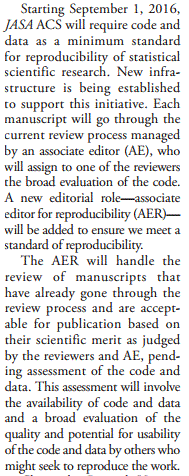
The American Statistical Association has recently introduced reproducibility requirements for articles published in its flagship journal, The Journal of the American Statistical Association.

The following is extracted from p.17 of the July 2016 issue of Amstat News:


Coming from one of the most prestigious statistics journals, this is good news for everyone!

We could do with more of this in the econometrics journals, and in those economics journals that publish empirical studies. 

To that end, I again commend The Replication Network.


© 2017, David E. Giles

Saturday, December 31, 2016

New Year's Reading

New Year's resolution - read more Econometrics!
  • Bürgi, C., 2016. What do we lose when we average expectations? RPF Working Paper No. 2016-013, Department of Economics, George Washington University.
  • Cox, D.R., 2016. Some pioneers of modern statistical theory:A personal reflection. Biometrika, 103, 747-759
  • Golden, R.M., S.S. Henley, H. White, & T.M. Kashner, 2016. Generalized information matrix tests for detecting model misspecification. Econometrics, 4, 46; doi:10.3390/econometrics4040046.
  • Phillips, G.D.A. & Y. Xu, 2016. Almost unbiased variance estimation in simultaneous equations models. Working Paper No. E2016/10, Cardiff Business School, University of Cardiff. 
  • Siliverstovs, B., 2016. Short-term forecasting with mixed-frequency data: A MIDASSO approach. Applied Economics, 49, 1326-1343.
  • Vosseler, A. & E. Weber, 2016. Bayesian analysis of periodic unit roots in the presence of a break. Applied Economics, online.
Best wishes for 2017, and thanks for supporitng this blog!

© 2016, David E. Giles

Thursday, December 29, 2016

Why Not Join The Replication Network?

I've been a member of The Replication Network (TRN) for some time now, and I commend it to you.

I received the End-of-the-Year Update for the TRN today, and I'm taking the liberty of reproducing it below in its entirety in the hope that you may consider getting involved.

Here it is:

Wednesday, December 28, 2016

More on the History of Distributed Lag Models

In a follow-up to my recent post about Irving Fisher's contribution to the development of distributed lag models,  Mike Belongia emailed me again with some very interesting material. He commented:
"While working with Peter Ireland to create a model of the business cycle based on what were mainstream ideas of the 1920s (including a monetary policy rule suggested by Holbrook Working), I ran across this note on Fisher's "short cut" method to deal with computational complexities (in his day) of non-linear relationships. 
I look forward to your follow-up post on Almon lags and hope Fisher's old, and sadly obscure, note adds some historical context to work on distributed lags."
It certainly does, Mike, and thank you very much for sharing this with us.

The note in question is titled, "Irving Fisher: Pioneer on distributed lags", and was written by J.N.M Wit (of the Netherlands central bank) in 1998. If you don't have time to read the full version, here's the abstract:
"The theory of distributed lags is that any cause produces a supposed effect only after some lag in time, and that this effect is not felt all at once, but is distributed over a number of points in time. Irving Fisher initiated this theory and provided an empirical methodology in the 1920’s. This article provides a small overview."
Incidentally, the paper co-authored with Peter Ireland that Mike is referring to it titled, "A classical view of the business cycle", and can be found here.

© 2016, David E. Giles

Tuesday, December 27, 2016

More on Orthogonal Regression

Some time ago I wrote a post about orthogonal regression. This is where we fit a regression line so that we minimize the sum of the squares of the orthogonal (rather than vertical) distances from the data points to the regression line.

Subsequently, I received the following email comment:
"Thanks for this blog post. I enjoyed reading it. I'm wondering how straightforward you think this would be to extend orthogonal regression to the case of two independent variables? Assume both independent variables are meaningfully measured in the same units."
Well, we don't have to make the latter assumption about units in order to answer this question. And we don't have to limit ourselves to just two regressors. Let's suppose that we have p of them.

In fact, I hint at the answer to the question posed above towards the end of my earlier post, when I say, "Finally, it will come as no surprise to hear that there's a close connection between orthogonal least squares and principal components analysis."

What was I referring to, exactly?

Monday, December 26, 2016

Specification Testing With Very Large Samples

I received the following email query a while back:
"It's my understanding that in the event that you have a large sample size (in my case, > 2million obs) many tests for functional form mis-specification will report statistically significant results purely on the basis that the sample size is large. In this situation, how can one reasonably test for misspecification?" 
Well, to begin with, that's absolutely correct - if the sample size is very, very large then almost any null hypothesis will be rejected (at conventional significance levels). For instance, see this earlier post of mine.

Schmueli (2012) also addresses this point from the p-value perspective.

But the question was, what can we do in this situation if we want to test for functional form mis-specification?

Schmueli offers some general suggestions that could be applied to this specific question:
  1. Present effect sizes.
  2. Report confidence intervals.
  3. Use (certain types of) charts
This is followed with an empirical example relating toauction prices for camera sales on eBay, using a sample size of n = 341,136.

To this, I'd add, consider alternative functional forms and use ex post forecast performance and cross-validation to choose a preferred functional form for your model.

You don't always have to use conventional hypothesis testing for this purpose.

Reference

Schmueli, G., 2012. Too big to fail: Large samples and the p-value problem. Mimeo., Institute of Service Science, National Tsing Hua University, Taiwan.


© 2016, David E. Giles

Irving Fisher & Distributed Lags

Some time back, Mike Belongia (U. Mississippi) emailed me as follows: 
"I enjoyed your post on Shirley Almon;  her name was very familiar to those of us of a certain age.
With regard to your planned follow-up post, I thought you might enjoy the attached piece by Irving Fisher who, in 1925, was attempting to associate variations in the price level with the volume of trade.  At the bottom of p. 183, he claims that "So far as I know this is the first attempt to distribute a statistical lag" and then goes on to explain his approach to the question.  Among other things, I'm still struck by the fact that Fisher's "computer" consisted of his intellect and a pencil and paper."
The 1925 paper by Fisher that Mike is referring to can be found here. Here are pages 183 and 184:


Thanks for sharing this interesting bit of econometrics history, Mike. And I haven't forgotten that I promised to prepare a follow-up post on the Almon estimator!

© 2016, David E. Giles

Saturday, December 24, 2016

Top New Posts of 2016

Thank you to all readers of this blog for your continued involvement during 2016.

Of the new posts released this year, the Top Five in terms of page-views were:
  1. Forecasting From an Error Correction Model
  2. I Was Just Kidding......!
  3. Choosing Between the Logit and Probit Models
  4. The Forecasting Performance of Models for Cointegrated Data
  5. A Quick Illustration of Pre-Testing Bias
Season's greetings!

© 2016, David E. Giles